Introduction
Fiber Laser Welding has transformed the welding industry, offering unparalleled precision and speed. Unlike traditional methods, it uses a focused laser beam to join materials with incredible accuracy and efficiency. In this article, we will explore the main advantages, systems, and applications of fiber laser welding. You’ll discover why it’s rapidly becoming the preferred choice across various industries.
What is Fiber Laser Welding?
Fiber Laser Welding is a modern welding method that utilizes a fiber laser beam to melt and join metals. Unlike traditional welding techniques, fiber lasers provide a highly focused light source that delivers energy precisely where it’s needed, with minimal heat input. This results in clean, precise welds with less distortion.
How Fiber Laser Welding Works
Fiber lasers use a laser diode to pump light into the core of an optical fiber. This fiber is doped with rare-earth elements, which absorb the light and re-emit it as a coherent laser beam. The laser beam is focused onto the material to be welded, generating enough heat to melt the material and create a strong bond between the workpieces.
Key Components of a Fiber Laser Welding System
A typical fiber laser welding system includes several key components:
● Laser Source: Generates the laser beam using a diode laser.
● Fiber Optic Cable: Carries the laser beam to the welding head with high flexibility.
● Welding Head: Focuses the laser beam onto the material to ensure an accurate weld.
● Workpiece Holder: Secures the material during the welding process.
Comparing Fiber Laser Welding to Traditional Methods
When compared to traditional welding methods like MIG and TIG welding, fiber laser welding stands out due to its speed, precision, and efficiency. Traditional methods often require more heat, which can distort materials, while fiber lasers minimize heat input, reducing distortion and improving weld quality.
Feature | Fiber Laser Welding | Traditional Methods (MIG/TIG) |
Speed | Faster production cycles | Slower compared to fiber lasers |
Precision | High precision, minimal distortion | Moderate precision, more distortion |
Heat Input | Low heat input, minimal distortion | Higher heat input, more distortion |
Efficiency | High efficiency, low maintenance | Lower efficiency, more maintenance required |
Advantages of Fiber Laser Welding
Fiber laser welding brings numerous benefits that distinguish it from traditional methods. Here are the key advantages:
Speed and Efficiency
Fiber laser welding is significantly faster than conventional welding methods, completing tasks up to 10 times quicker. This increased speed leads to shorter production cycles and greater overall productivity.
Precision and Accuracy
The focused laser beam allows for high-precision welding, even on complex shapes and thin materials. Fiber lasers can also weld dissimilar metals, something that traditional welding methods struggle with.
Low Heat Input and Reduced Material Distortion
One of the most significant advantages of fiber laser welding is its low heat input. This minimizes the heat-affected zone (HAZ), reducing material distortion, thermal stress, and the likelihood of cracks in the workpiece.
Compact and Low Maintenance
Fiber laser systems are compact, requiring less floor space compared to traditional welding systems. They are also low-maintenance, reducing downtime and operational costs. Their solid-state design means fewer moving parts, resulting in less wear and tear.
Advantage | Fiber Laser Welding |
Speed and Efficiency | Up to 10 times faster, shorter production cycles |
Precision and Accuracy | High precision, works on complex shapes and dissimilar metals |
Low Heat Input and Reduced Distortion | Minimizes heat-affected zone, reduces material distortion and cracks |
Compact and Low Maintenance | Requires less space, low maintenance, fewer moving parts |
Fiber Laser Welding Systems
There are several types of fiber laser welding systems, each designed to meet different needs. Understanding the available systems is crucial when selecting the right one for your application.
Handheld Fiber Laser Welders
Handheld fiber laser welders are portable and easy to use, making them perfect for small-scale or repair tasks. These systems offer flexibility for welding in various locations without the need for extensive setup.
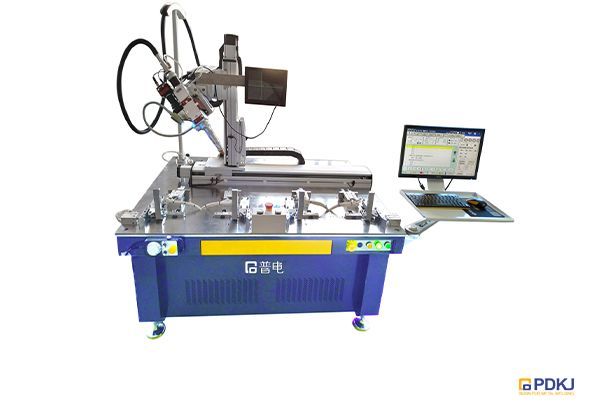
Fixed Fiber Laser Welding Workstations
Fixed systems are designed for high-precision welding in controlled environments. These workstations are ideal for industries requiring consistency and repeatability in their production processes.
Robotic Fiber Laser Welding Machines
Automated robotic systems integrate fiber laser welding technology with robotics, providing high-efficiency, high-speed production for large-scale manufacturing. These systems are ideal for repetitive tasks and complex welding jobs.
Hybrid Systems: Robot-Assisted Laser Welding
Hybrid systems combine the flexibility of a robotic arm with manual control for highly customizable welding applications. This type of system is ideal for industries that require both high precision and flexibility.

Applications of Fiber Laser Welding
Fiber laser welding is used in various industries due to its versatility and high precision. Here are some of the key industries where fiber laser welding is making a significant impact:
Automotive Industry
Fiber laser welding plays a vital role in manufacturing automotive components like body panels, battery modules, and exhaust systems. It improves strength, durability, and weight efficiency while ensuring consistent weld quality.
Aerospace Applications
In the aerospace sector, fiber laser welding is used to manufacture lightweight, high-strength components such as turbine blades, fuselage sections, and engine parts. The precision of fiber lasers ensures minimal distortion in critical aerospace materials.
Medical Devices and Implants
Fiber laser welding is crucial in the medical industry for welding small, intricate parts of medical devices, such as implants, surgical tools, and pacemakers. The high precision and biocompatibility ensure that these devices meet stringent safety and performance standards.
Electronics Manufacturing
Fiber lasers are used extensively in electronics for welding circuit boards, connectors, and sensors. Their precision allows for the creation of strong and reliable joints that are crucial in electronics where miniaturization and durability are key.
Jewelry and Decorative Applications
In the jewelry industry, fiber laser welding is used to create fine, aesthetic welds on items such as rings, necklaces, and bracelets. The precision offered by fiber lasers allows jewelers to work with delicate materials without affecting their visual appeal.
Industry | Application |
Automotive Industry | Welding body panels, battery modules, exhaust systems |
Aerospace | Manufacturing turbine blades, fuselage sections, engine parts |
Medical Devices | Welding implants, surgical tools, pacemakers |
Electronics Manufacturing | Welding circuit boards, connectors, sensors |
Jewelry and Decorative | Creating fine, aesthetic welds on rings, necklaces, bracelets |
Limitations and Challenges of Fiber Laser Welding
While fiber laser welding is an innovative and efficient technology, there are some challenges and limitations that businesses must consider before adopting it.
High Initial Cost
The cost of fiber laser welding systems can be high, especially for industries new to this technology. While the systems can reduce operational costs over time, the initial investment may be a barrier for smaller companies.
Limited Thickness Capacity
Fiber laser welding is most effective for thin to medium materials. Welding very thick materials may require a more powerful system or a different welding method altogether, making it less versatile in certain heavy-duty applications.
Skill and Training Requirements
Operating fiber laser welding systems requires skilled operators who understand the nuances of laser settings for different materials. Training costs can add up, particularly for businesses looking to transition to this advanced technology.
Sensitivity to Contaminants
The fiber optic cables used in fiber laser welding systems are sensitive to contaminants like dust and dirt. These particles can affect the performance of the system, requiring regular maintenance and cleaning.
Limitation/Challenge | Details |
High Initial Cost | High upfront investment, especially for newcomers |
Limited Thickness Capacity | Best for thin to medium materials, less effective on thick materials |
Skill and Training Requirements | Requires skilled operators, training costs can be significant |
Sensitivity to Contaminants | Fiber optic cables sensitive to dust and dirt, requires regular maintenance |
Future Trends in Fiber Laser Welding
As manufacturing needs continue to evolve, fiber laser welding is expected to play a growing role in modern industrial processes. Here are some emerging trends and advancements in the field:
Integration with Additive Manufacturing
Fiber laser welding can be integrated with 3D printing technologies, offering a new level of precision and customization. This combination can create more complex and durable components that traditional methods cannot achieve.
Increased Automation and Smart Manufacturing
With the rise of smart manufacturing, fiber laser welding is expected to integrate more seamlessly with automated systems and AI-driven processes. These advancements will increase the speed, accuracy, and flexibility of production lines.
Eco-Friendly and Sustainable Practices
Fiber laser welding's low energy consumption and minimal waste generation make it an eco-friendly option for many industries. As businesses become more focused on sustainability, fiber laser welding is poised to be a key component in reducing the environmental impact of manufacturing.
Conclusion
Fiber Laser Welding is revolutionizing industries by offering a highly efficient, precise, and versatile solution. It provides faster production cycles, minimal distortion, and high-quality welds compared to traditional methods. Despite challenges like high initial costs, its benefits make it essential for industries such as automotive and aerospace. Guangdong PDKJ Automation Technology Co., Ltd. delivers advanced fiber laser welding systems, helping companies improve production efficiency and weld quality. With ongoing technological advancements, fiber laser welding is poised to lead the future of manufacturing.
FAQ
Q: What is Fiber Laser Welding?
A: Fiber Laser Welding is a process that uses a focused laser beam to join materials with high precision and low heat input. It offers faster production cycles and minimal distortion compared to traditional welding methods.
Q: How does Fiber Laser Welding work?
A: Fiber Laser Welding works by using a laser diode to generate light, which is then transmitted through fiber optics to the welding head. The focused laser beam melts the materials, creating a strong bond with minimal heat impact.
Q: What are the advantages of Fiber Laser Welding over traditional methods?
A: Fiber Laser Welding offers faster speeds, high precision, low heat input, and reduced material distortion. These advantages make it ideal for applications requiring intricate welds and minimal defects.
Q: What industries use Fiber Laser Welding?
A: Fiber Laser Welding is widely used in industries such as automotive, aerospace, medical devices, electronics, and jewelry due to its precision, speed, and versatility.
Q: How much does Fiber Laser Welding cost?
A: While the initial investment in Fiber Laser Welding systems can be high, the efficiency, speed, and durability of these systems often result in long-term cost savings and improved production rates.
Q: Why is Fiber Laser Welding considered environmentally friendly?
A: Fiber Laser Welding is considered eco-friendly because it reduces waste, consumes less energy than traditional welding methods, and generates fewer pollutants, making it a sustainable option for manufacturing.