You are here: Home » News » Consulting Center » Handheld Laser Welders Vs. Robotic Laser Welders: An In-Depth Analysis of Production Capacity, Cost, And Application Scenarios
Handheld Laser Welders Vs. Robotic Laser Welders: An In-Depth Analysis of Production Capacity, Cost, And Application Scenarios
Views: 0 Author: Site Editor Publish Time: 2026-03-17 Origin: Site
In the field of metal welding and fabrication, laser welding has become the industry mainstream thanks to its advantages of strong weld strength, clean and aesthetic seams, minimal thermal deformation, and high efficiency, gradually replacing traditional welding processes.
Among laser welding solutions, the two core categories—handheld laser welding machines and robotic laser welding systems—have become key decision points for enterprises when purchasing equipment.
However, many companies fall into common selection pitfalls:
Blindly investing in robotic laser welding systems, only to face idle equipment due to low order volume or poor part compatibility
Over-relying on handheld laser welders, which fail to meet large-scale production demands and lead to missed business opportunities
In reality, neither option is absolutely better. The key differences lie in production capacity, total cost, and application scenarios. Only by aligning equipment with actual production needs can businesses truly improve efficiency and reduce costs.
This article provides a comprehensive comparison based on capacity, cost, and real-world applications, helping companies avoid selection mistakes and choose the most suitable welding solution.
1. Basic Definitions: Understanding the Core Differences
Before comparing, it’s important to clarify the positioning of each system:
Handheld Laser Welding Machine: Operated manually using a handheld welding gun. It is a semi-automatic solution offering maximum flexibility, widely used for small to medium production and custom processing.
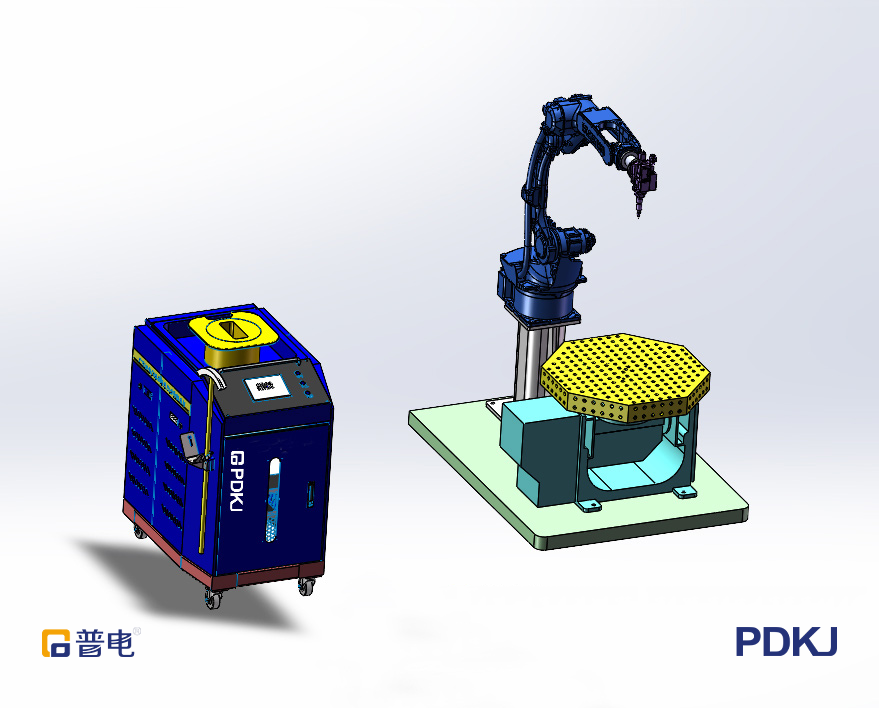
Robotic Laser Welding Machine: Based on industrial robots integrated with laser systems, fixtures, and worktables. It enables fully automated welding with minimal human intervention, designed for large-scale, standardized production.
2. Core Comparison: Capacity, Cost, and Application
2.1 Production Capacity: Manual vs Fully Automated
Handheld Laser Welding Machine:
3–5× faster than traditional welding (TIG/MIG)
Strong flexibility but heavily dependent on operators
Typically 1 operator per machine, 8 hours/day
Limited by labor fatigue and skill level
Inconsistent welding quality and speed
Not suitable for 24/7 operation or large-scale standardized production
Robotic Laser Welding Machine:
Fully automated with pre-programmed parameters and paths
Part Adaptability: Handheld = flexible for all shapes Robot = best for standardized parts
3. Advantages & Disadvantages Summary
Handheld Laser Welding Machine
Advantages:
Low investment
Easy to operate
High flexibility
Small footprint
Fast ROI
Suitable for irregular parts
Disadvantages:
Limited capacity
Labor-dependent
متوسط precision
Not suitable for mass production
Robotic Laser Welding Machine
Advantages:
Extremely high productivity
Fully automated
Superior precision
Stable and consistent quality
Ideal for large-scale production
Lower long-term labor cost
Disadvantages:
High initial investment
Requires skilled technicians
Less flexible
Higher maintenance cost
4. Selection Guide: Choose Based on Your Needs
Choose Handheld Laser Welding Machine if:
You are a small or medium-sized business with limited budget
Orders are small-batch, customized, or irregular
No professional technicians available
You prioritize flexibility and quick ROI
Choose Robotic Laser Welding Machine if:
You have stable, high-volume orders
Products are standardized
High precision and quality are required
You have budget and technical team
You aim for automation and long-term cost reduction
5. Final Thoughts
Handheld and robotic laser welding machines are not substitutes—they are complementary solutions.
Handheld machines excel in flexibility and low cost, ideal for small batches and custom jobs
Robotic systems excel in efficiency and precision, ideal for large-scale, standardized production
The key to equipment selection is not choosing the most expensive or the cheapest option, but aligning with your order volume, product type, budget, and production goals.
Choosing the right equipment ensures not only welding quality but also optimal cost-efficiency—helping you avoid both idle machines and insufficient production capacity.
If you are looking to purchase a laser welding machine, feel free to contact PDKJ. We provide professional solutions in handheld laser welding machines, robotic laser welding systems, and automated welding solutions, helping you select the most suitable equipment for your business.
If you have welding machine requirements, please contact Ms. Zhao
Founded in 2006, PDKJ is a professional supplier of welding automation solutions. The company has passed the ISO9001 international quality management system certification, has more than 90 officially authorized and applied national patents, and a number of core technologies in the welding field fill the technical gap at home and abroad. It is a national high-tech enterprise.